
Composable architecture enables sustainable commerce
The four core strategic initiatives for sustainability in a brand commerce context.
By Paul Tomlinson, Published 26.04.2024
‘Sustainability’, in a brand commerce context, breaks down into four core strategic initiatives:
- measurement: knowing the climate impact of your products and services with a high degree of certainty
- making the data useful: structuring and standardising data in the PIM, so that it can be processed in the ERP to decide whether, how, and where products are sold
- marketing: exposing that data to consumers, and to brand-side professionals, to support consumer demand for informed, sustainable shopping
- reporting & analytics: creating a unified view of sustainability across the business so that this can be understood, optimised and fed into marketing initiatives.
All these initiatives involve managing a great deal of complex data. As a result, marketing around sustainability is one of the more difficult objectives that a brand can embark on. So, this article will break down these four initiatives into actionable steps, identifying the technology and integrations that will be required at each stage.
As discussed in our recent ebook, a future-proof data strategy ultimately means migrating to composable technical architecture. In short, ‘composable architecture’ implies adopting technology specifically designed to increase the businesses’ data management capabilities.
This transformation is important for sustainability because – as we can see from widespread greenwashing – brands’ command of the facts is holding back their sustainability ambitions. That ultimately undermines brand trust, and paves the way for any competitors who are faster to get a grip on the data.
Getting a grip will soon become a legal requirement.
From 2026, regulations in California and the EU will force businesses to report on ‘scope 3’ emissions…
“…which include those generated by their suppliers and end users. For example, carmakers will have to account for the emissions of those who provide them with parts and those who drive their cars.”
Due to the size and influence of those two markets, this will likely force brands to make those changes globally, as other jurisdictions follow suit.
Facing such pressure, brands and technology companies are now making significant investments in the tools needed to accurately measure and manage emission data across their businesses. Though difficult, this is fast becoming achievable due to the increasing availability of tools for managing emissions data.
The next step for sustainable commerce, of course, is to be able to expose that data in marketing systems and customer-facing channels. This article sets out how to proceed.
Through most of this article, we’ll consider examples of high-volume CGP brands and retailers, since they’re the most complex use-case for sustainable commerce. If you work in an industry with a simpler carbon footprint (i.e., professional service, SaaS, etc.), you can overlook some of the complexity to find the parts that are relevant to your business.
This article was co-authored with Hamari Agency.
Measuring emissions data on your products and services
At product-level, the technology required to measure and manage emissions is the same as the tools used for managing a product life cycle – namely:
- supply chain management software
- the PLM (product lifecycle management system) and/or PIM (product information management). Traditionally, both these modules resided in the ERP or ecommerce platform, but they are increasingly licenced today as separate pieces of software, as these give businesses a much better handle on their product data.
Whenever a business launches a new product, it captures all necessary data about the product, its components/ingredients, its manufacturing process and all other properties. These data include cost, pricing, size, shape, weight, images, safety information, etc., with additional data fields properties for product variants.
In principle, adding data fields for emissions factors (carbon emissions, deforestation impact, water usage, etc.) is quite a simple idea. Product attributes, including emissions data, would typically be stored and captured in the PIM – and/or in the PLM if the business operates one.
Importantly, the PIM is not limited to storing data on the products you sell. It can also be used for services, which can be productised, and for products or services you buy as a reseller or manufacturer (i.e., materials/ingredients, energy, tools).
To get this data from the supplier, the most efficient setup is for the brand to operate composable modules for the PIM/PLM and the supply chain management solution. Examples of modern, composable PIM solutions include Pimcore, Pimberly, Inriver and Salsify.
Such solutions avoid the need to manually import supplier data into their ERP – and also much of the slow and costly custom integration work previously needed to connect to the suppliers’ systems. Modern supply chain and PIM/PLM solutions answer this problem in the design of their APIs, to enable fast, low-cost integrations and the smooth flow of data.
This is important, because the complexity of product data can vary greatly from one business to the next – and the choices, of which data to record and display, change depending on the product or service category.
If you’re a small online bakery, you might only have a few supplier products/services to consider: several dozen ingredients, packaging, services including energy and property, and delivery partners.
If you’re a supermarket or a retailer you have a far more complex picture. For example, iPhones comprise components from 200 different manufacturers. If such a retailer stocks several thousand different line-times, there could be millions of data points for sustainability alone.
So, to make this data as accurate and up-to-date as possible, brands require flexible and easily-adaptable technology in which the following data flows are maintained:
- between your supply chain management system and your PIM/PLM – so that accurate and up-to-date supplier data (where available) is updated in the PIM in real-time
- between the PIM and the ERP so that this emissions data can be used for commercial decision-making (see next section)
- …and, between the PIM and third-party resources, such as Open Food Facts, which provide estimates of emissions data for certain products / product types (because in many cases supplier data will be lacking).
This data will be changing continuously, likely producing thousands of API calls per day at an enterprise brand. This further illustrates why composable technical architecture is required for brands to truly get a grip on their emissions.

Composable ecommerce stacks are designed to enable better flow and management of data throughout the business – for carbon emissions, and many other purposes.
Consider the hypothetical example of a brand which switches to an avocado supplier that’s 4,000 miles closer than the old one, completely transforming the carbon footprint of products containing that ingredient. Or, perhaps a period of poor weather which causes farms to rely more heavily on greenhouses, energy or fertiliser, temporarily increasing the emissions of food or cotton products from that supplier for a season.
The brand may also wish to take advantage of third-party data tools to help measure and manage such fluctuations; Plan A, a carbon accounting platform, has a dedicated module for measuring ‘scope 3’ emissions.
As we’ll discuss later on, such data needs to be exposed in a range of places, ranging from the ecommerce customer experience, to marketing tools, to your packaging suppliers where product labels are printed.
You will likely also wish to expose this data externally, to third-party resellers or regulators, which adds to the requirement for flexible, adaptable APIs.
This simply isn’t scalable with traditional, monolithic tools for product lifecycle management. The transfer of data is too manual, too slow, and over-reliant on expensive custom technology development.
Making product emissions data useful to the business
Knowing that a product or service emits “X” tons of carbon per kilogram, or consumes “Y” litres of water per tonne, is not that useful.
The business needs to view this data in the context of the decisions it makes regarding that product, such as:
- should we sell this product?
- should we change the price or bundling according to its environmental impact?
- should we only sell it to people who are not that environmentally conscious?
- should we only sell it in certain locations where a given environmental impact is permitted or culturally acceptable?
- should we only manufacture or sell this product at times when the raw materials can be sourced below a specified level of C02/kg – and pause production otherwise?
Brands already use the ERP to determine how a product will be priced and marketed, and at what volumes it will be sold. This decision-making is largely automated, based on algorithms which draw on the large number of different data points, and determines certain actions if the product falls above or below a certain ROI (and other metrics).
For a few years now, this same technology module has been used to consider the environment as part of higher-level business decisions. In 2021, a McKinsey article on supply chain decarbonisation reported…
“CFOs and other business leaders will likely require much more accurate, granular, and timely emission transparency to run the business in the future… Recognizing that need, established ERP vendors and recent start-ups are now offering carbon-accounting platforms.
Some allow for targeted emission calculation using utility bills, travel, and logistics patterns; others link footprint insights immediately to offsetting marketplaces. At the same time, traditional corporate-transaction-system providers have started to add carbon accounting to their ERP and customer-relationship-management (CRM) systems.”
For the purposes of sustainable brand marketing, the ERP needs to be able to process similar data at individual product-level. This will rely on a scoring system, which takes into account all emissions factors of a product, based on materials, weight, delivery miles, delivery method, packaging.
This scoring should take place in the PIM, and then be exposed in the ERP in for the following types of decisions to be made:
- if a product is only a 0.4 for ROI, but is a 0.9 for sustainability, you might decide to produce more of that product, expecting that it would please certain customers and sell at greater volumes
- if the product is a 0.6 for ROI, but is only a 0.3 for sustainability, you might cease new production, but sell remaining stocks because the cost of wastage is too high
- if it’s a 0.2 or lower for sustainability, you might pull all remaining stocks from sale, because a 0.2 doesn’t fit in with your brand image and the reputational risk outweighs the cost of wastage.
For the products which you determine are suitable for sale, the next step is to format that data so that it can be exposed in the customer experience, so that the customer can make informed buying decisions.
Exposing emissions data for digital commerce
Many different consumer products may have 12 or more different variations, i.e., on size, colour, finish etc., and it may be that the environmental impact will change from one to the other.
For instance, the same armchair may be finished in leather, organic textile, or leather-effect plastic – with different emissions for each finish.
Product variations such as this are stored in the PIM as what’s known as ‘parent’ and ‘child’ attributes. This diagram shows a typical product hierarchy where the ‘parent’ is the product line (the iPhone 11), and the ‘child’ attributes are different variations on that product.

This parent/child structure could also apply to emissions scoring.
In the armchair example above, the ‘parent’ attribute might be an average sustainability score of 0.5 across all variations of the armchair. The child scores, however, might show that the textile is actually a fairly damaging 0.3 due to water and land usage, whereas the leather is a more planet-friendly 0.7 since it’s biodegradable and sourced as a by-product.
In such a setup, you would want the 0.5 score to be exposed in your ecommerce store’s main product grid, but the child scores to be exposed when a customer selects on one of the variations.
You would also want a configurator in the PIM which allows you to determine which emission factors to consider for different products. In many cases, carbon footprint would be sufficient, but for controversial products such as almond- or palm oil-based products, customers might prefer to see data on land and water usage.
*
Across the commerce landscape, brands are requiring far greater capability around product information. This is driving brands towards modern, composable PIMs, which are more adaptable, and which anticipate a wider range of use-cases and integrations.
Bruce Wright, VP Sales at Pimberly, says that their solution can handle five sub-layers of child attributes. This is one factor causing brands to migrate to more modern PIM vendors – and brands wishing to control the various emissions factors across their entire product range will likely need to follow suit.
Really, any modern, composable PIM will give brands far more flexibility to manage emissions data than the one built into their ecommerce platform.
Making sustainability data useful for marketing purposes
Today, brands continue to make highly generic and obscure claims about sustainability, which are of little help to customers who want to make informed choices about their everyday shopping.
We discussed this in an article a few years ago but there are essentially three components to the problem.
1. Wide variation in customers’ interest in sustainability
Contrary to popular belief, most customers will not shift share of wallet towards sustainable propositions.
This is known as the ‘say-do gap’. Whereas a majority of consumers say they would pay more for an eco-friendly product, multiple pieces of research have shown that price, quality and personal taste usually take preference.
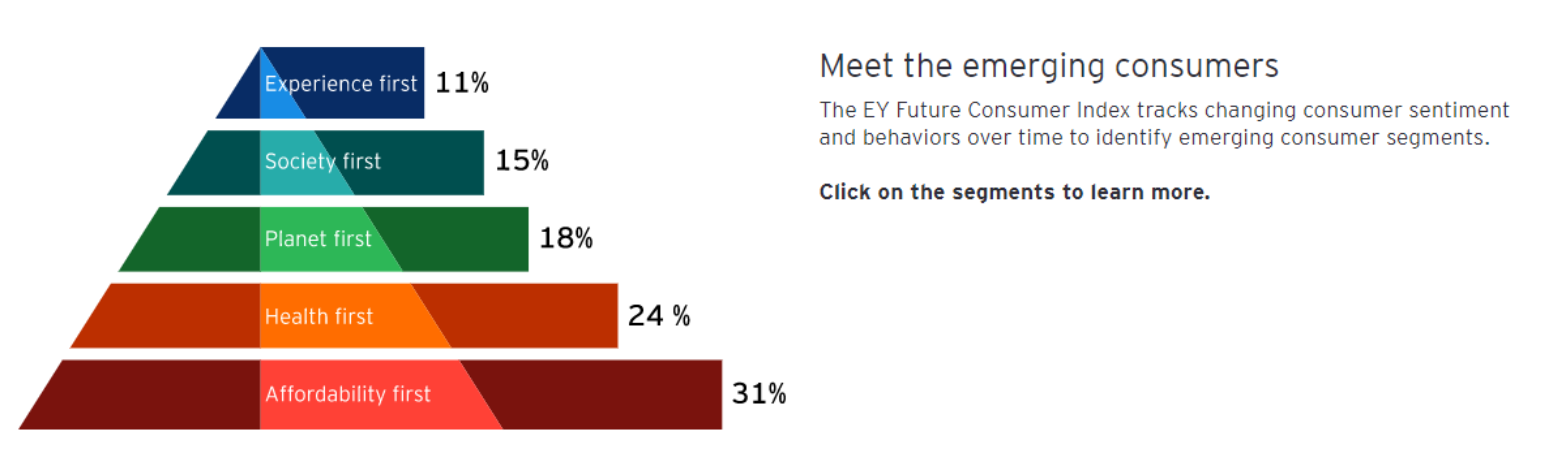
This is a major headache for brands because sustainable alternatives to everyday products typically cost brands a lot more to produce. You also risk wasting marketing resources if you promote them to all customers, not to mention racking up financial and carbon costs on junked emails, ignored media ads, and irrelevant customer experiences.
Of course, there is also a major commercial opportunity in promoting sustainability to the 20-25% of customers who are passionate about the environment – since you can earn greater profits on more expensive products.
2. Only making claims at brand-level, rather than product-level
Some customers favour certain brands for their sustainable positioning (i.e., Patagonia, Lush Cosmetics, etc.) however, this overlooks the fact that these brands have diverse product portfolios.
Consider the example of a company with a relatively low carbon footprint, which puts a generic ‘eco-label’ on the packaging of all its 2,000 products. That includes, however, the 5-10% of products which are actually more harmful than some competitors’ – causing customers to make less-sustainable buying decisions.
3. Displaying unintelligible or meaningless information
Some brands (such as Cocokind; pictured) display their carbon impact of different products – but most customers have no idea whether a certain CO2/kg figure is good or bad.
For the few that do, this data still isn’t that helpful unless they can make comparisons from one product to the next.

Recently, consumer goods brands in particular have begun to migrate to colour-coded labels which rate the product on a scale, such as the ‘Eco-score’ label launched in 2021, by a coalition of French brands.
This is a step in the right direction, but it’s flawed, because it causes the consumer the environmental impact of a product in isolation, rather than in the context of its category.
Illustratively: nearly all chocolate and coffee is rated D or E, i.e. quite harmful. Most customers simply aren’t going to buy a ‘C’ rated ‘Skinnybar’ over a Twix or a KitKat. So this doesn’t really aid the customer’s decision-making.
Nor is any manufacturer really going to be pleased about a ‘D’ (or even a ‘B’) being slapped on its product.
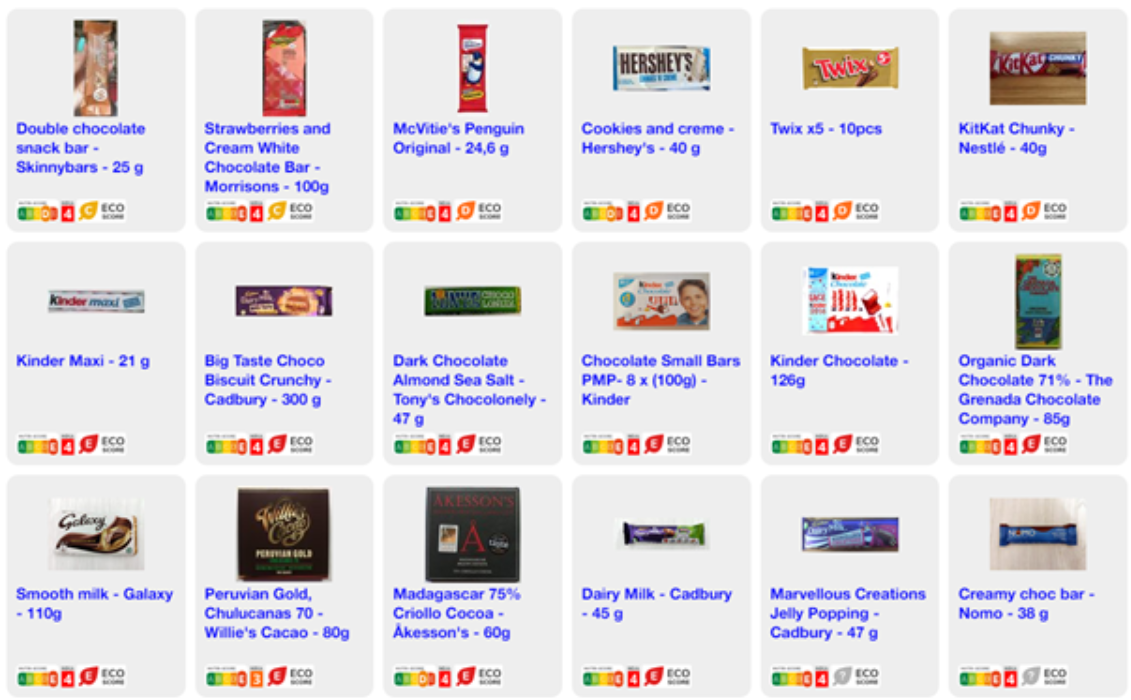
More to the point, brands could be showing much more useful data – such as the percentage improvement in the sustainability of that product, or of the brand.
If the product has gone from an ‘E’ to a ‘D’ over 12 months, the most valuable piece of messaging would be that you’ve slashed the carbon footprint of that product by ~20%. That’s an impressive figure, which everyone can understand.
*
These problems are, however, surmountable – and overcoming them opens up an entirely new frontier in marketing.
To capitalise, brands need the tools to:
- display accurate sustainability data at the point of sale
- target that information based on the customer’s interests
- harness engagement data to create a feedback loop which further enhances the customer profile.
The tools required to achieve this are already widely in use, since they are essentially the same martech components which brands are already using for marketing personalisation.
Displaying accurate product emissions data at the point of sale
A very basic example of how this might look in an ecommerce context comes from Trainline, a UK marketplace for rail travel.
When you enter your journey location, the interface shows you how much carbon you’d save by rail travel compared to driving.

This is quite useful, because it provides a familiar reference point for the environmental impact.
But it’s also quite a simple use-case. Trainline only sells one product – train journeys – and this calculation probably only draws on two third-party data sources:
- the driving distance between two stations
- and the average carbon emissions per mile of a car.
Most retailers would find it more challenging to display such information across their inventory, in all commerce settings.
To return to the example of the armchair retailer…
Let’s say the brand’s linen supplier successfully reduces its carbon footprint. You would like to know that that data passes straight through the supply chain management system into the brand’s ecommerce stack. The textile-finish armchair might then improve from a 0.3 to a 0.5 – and the product category overall improves to a 0.6. That might trigger a calculation in the ERP, whereby you then decide to manufacture more of the linen product variant as it better serves your carbon reduction targets.
Of course, that only counts for anything if people buy the product, so you would like that data to automatically update in commerce channels – whether owned channels, or third party (i.e., Amazon).
For offline retail, you would also like to integrate your print management software, so that your product labels can be automatically updated without having to make design changes to the assets.
If the same retailer has 1,000 products, 5,000 product variations, and several hundred different raw materials in its supply chain, these updates would need to happen automatically. Manually managing such complex flows through imports/exports of data would simply incur overly great dependency on your IT department and commerce team.
*
Such a scenario is becoming eminently possible as brands migrate towards the composable commerce stack. Most of these developments are not taking place for the purpose of sustainability.
In some cases, it’s to drive operational efficiency by getting a better handle on product data across the business. A good example is a recently-announced integration between Linnworks, an inventory vendor, and Lightspeed, an ePOS vendor, which is intended to improve brands’ unified view of product inventory across ecommerce and physical retail channels.
In other cases, it’s adding new revenue streams, or increasing command of the customer data.
Some ecommerce platforms now offer out-of-the-box integrations to social media channels (such as Shopline’s connection to TikTok). Similarly, the rise in DXPs (digital experience platforms) is largely down to brands’ greater investment in multichannel commerce. Air France-KLM’s adoption of the Contentstack DXP is intended to “provide seamless and curated omnichannel experiences to its customers worldwide”.
Whatever the drivers of change, the point is that brands are already in the process of adopting tools which allow the fast, automated flow of data between administrative function, martech tools, and in customer-facing settings.
This lays the groundwork for effective marketing personalisation, based on customers’ personal environmental preferences and goals.
Targeting and personalisation based on sustainability
Every brand already has the capability to maintain a ‘sustainability segment’ in its CRM or CDP (customer data platform). This could actually be a few different segments, such as:
- customers who will spend more money to shop sustainably
- customers who engage positively with environmental content – whether or not they change their spending habits at checkout
- customers who are interested in a specific emissions factor – whether carbon, deforestation, endangered species, or even human rights (which is recorded as an emissions factor in some frameworks).
The question is how effectively brands can deploy this data for marketing purposes.
Part of this is improving command of the customer data. This is steadily taking place as brands work to improve their personalisation efforts, but essentially boils down to maintaining a single, enterprise CRM and CDP (customer data platform).
That CDP may be licenced as a standalone piece of technology (i.e., Hightouch), but many brands are sufficiently well-served by the CDP contained within their CRM. In any case, this area of the technology stack serves two purposes:
- drawing on all the brands’ different customer data sources (i.e., your automation platform, ecommerce platform, loyalty platform, etc) to build a single source of truth about the customer’s preferences
- pushing that data into marketing contexts, so that marketing can be targeted and personalised without IT support.
If a customer buys a palm-oil free soap or shampoo, you may have struck gold, because you now know the customer can spend 2-4x the usual price for soap in order to be environmentally friendly.
This likely means you have a higher-income individual who will be highly motivated to spend more, if you show them offers for other products which you can credibly demonstrate are environmentally friendly.
So, you would want that purchase of a soap bar to update that customer’s record in the CDP, be used to determine which offers they see in the future, and to shape their wider interactions with the brand.
Similarly, you would want to avoid showing certain pieces of information to the wrong people. That same customer might be a vegan, and react very poorly to an ad for a leather armchair – even if it is the most carbon-efficient product variant in the range.
*
Composable CX (customer experience) solutions are now widely used by brands who want to personalise customer experiences in this way, and benefit from feedback loops that inform future marketing.
DXPs such as Magnolia and Optimizely combine your ecommerce, automation and CRM/CDP modules, so that you can carry out such personalisation across most of your marketing channels from a single platform.
Alternatively, pureplay front-end vendors, such as Vue Storefront and Contentful, will also give the option of integrating with automation/personalisation tools such as Bloomreach and ActiveCampaign to achieve similar goals.
The point is, if you have already migrated to composable commerce architecture, then the ability to commercialise emissions data through marketing personalisation is greatly enhanced.
To reiterate, around 25% of customers will proactively shift spending towards sustainable propositions – if the brand can successfully target those people with the right information.
With most businesses simply slapping eco-labels on their products, this is a valuable opportunity which remains untapped at the majority of brands.
Repurposing corporate-level emissions data for marketing purposes
Brands have made significant progress, in recent years, in emissions management and reporting at corporate level.
This has been driven by a combination of regulation and public pressure. Governments in most developed countries have required some level of carbon reporting by companies for 10 years or more.
Doubts remain about the accuracy and utility of the data being reported – but the good news, for marketers, is that carbon management and automation is now a relatively mature software category.
That paves the way for this data to become of greater use for marketing and commerce.
One such software vendor is Climatiq, a data solution which helps to standardise and organise the company’s emissions data from across the business, enhancing this with third-party data where necessary. The Climatiq API provides access to a database of known emissions factors to help the business calculate carbon emissions in their business.
As this diagram shows, the composable nature of this software is intended to integrate with the wider business stack.
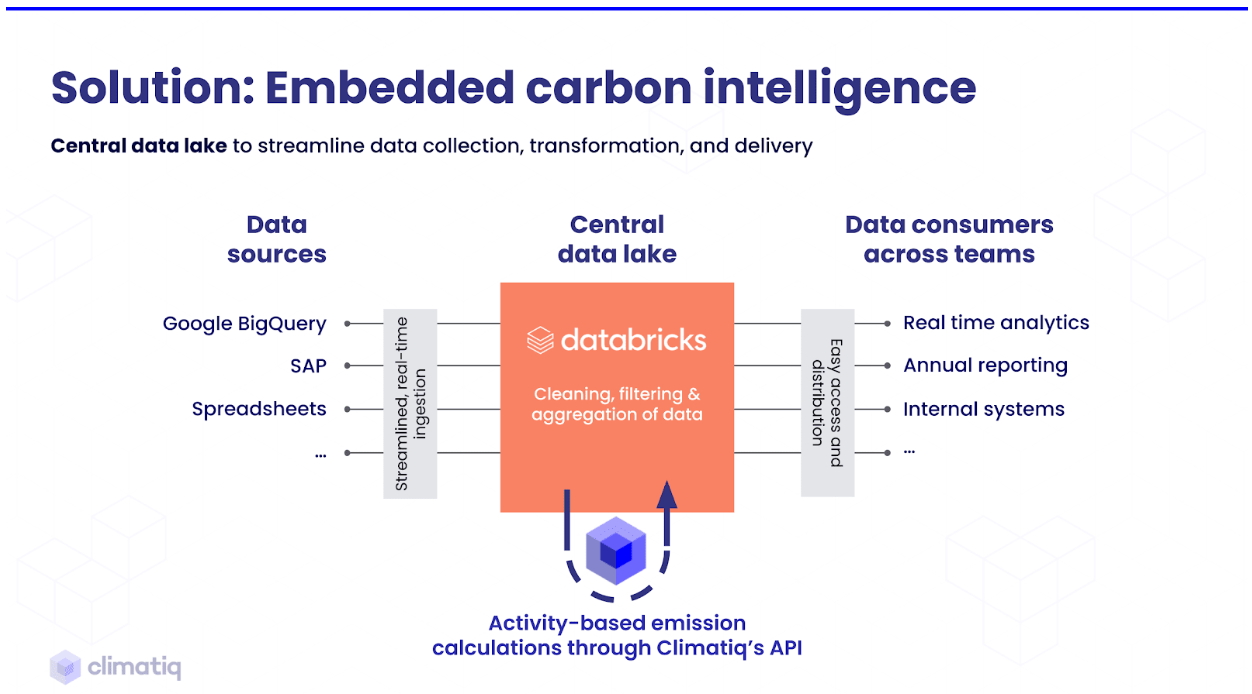
This diagram doesn’t quite convey all the data inputs and outputs that would be needed for sustainable marketing.
The ecommerce stack could be both an input and output.
On the data source side: emissions data across the portfolio should feed into your carbon automation software, so that, as the emissions of your product range fluctuate, this is reflected in corporate-level reporting.
Individual fluctuations for a given product won’t change very much, but some will change radically. Enterprise brands are vulnerable to factors such as extreme weather, and geopolitical events, which affect where goods are bought and how they are shipped.
Any brand in Europe importing from Asia probably saw its products’ carbon footprint treble, in early 2024, as the Gaza war forced shipping companies to avoid the Red Sea by sailing around Africa instead.
Your suppliers in Asia aren’t going to calculate this for you – but you can quite easily estimate the increased consumption of shipping fuel at a corporate level. That data can then be disseminated across your product portfolio based on the size/mass of affected materials and components.
Such changes happen at such scale, and with such frequency at enterprise brands, that composable carbon automation is the only effective way to ensure this data is reflected fairly and accurately across the business.
On the data consumption side: you would want consumer buying trends to be reflected in corporate-level reporting.
For instance, many brands now offer sustainable shipping options, where the product is taken to a post office or convenience store rather than the customer’s home address.
This produces a fairly-easily calculable carbon saving which can be aggregated across the business and pushed into your corporate emissions dashboard, published in shareholder marketing, and reported to regulators.

Some brands now publish fairly detailed marketing about the eco-friendliness of their products. This spread, from ‘The Food Fight’ impact report, by Sir Kensington’s (a CPG food brand), uses this data to justify the relatively high cost of its ingredients.
*
Regulation around emissions data continues to tighten, so brands are already in the progress of adopting carbon automation tools such as Climatiq.
In most cases, this data is not yet trickling down to individual product level, but there are precedents for these types of data flows in other areas.
A good example is tax compliance. In the United States, tax compliance is hugely complicated, to the degree that individual businesses in the same city may have different tax codes. Companies such as Avalara, a piece of tax compliance software, have invested heavily in ecommerce integrations, permeating a large proportion of the business stack to keep clients on the right side of the law.
Those integrations are needed with both back-end and customer-facing systems. On the front-end, this ensures the right amount of tax is charged on every product, wherever it’s ordered. On the backend, the business can be confident it’s paying the right amount of tax on supplies, wherever they’re shipped from.
Carbon compliance may never be regulated as stringently as taxation. But with an issue as emotive as sustainability, you would expect that many brands will make such developments under their own steam.
The technology needed to execute on this at scale is now widely available, and brands’ technical architecture around emissions, marketing and data are improving anyway.
For brands already on those paths, the next logical step is to connect the dots between better management of emissions data, and better communication with customers.
This is not only for the purpose of working towards a more sustainable world. With the significant marketing opportunities around sustainability, there’s a commercial lift on the table for brands forward-thinking enough to make the move.
About the authors
 Fareed Patel is the co-founder of Hamari, a digital agency which builds software with complex data across digital and print channels. They help clients clarify their digital journey and streamline processes into digital experiences. By simplifying data and integrating systems they deliver transformative change for our clients. Hamari is one of the UK’s best-established Pimcore agencies.
Get in touch with Fareed Patel on LinkedIn.

Paul Tomlinson is the founder of Navigate B2B, a content agency specialising in MACH architecture and SaaS scaleups. We collaborate with the leaders of high-growth technology companies to translate their unique sector expertise into high-quality marketing content. As a full-service agency with strategy, advertising and creativity on-tap, we ensure that your marketing is moving the needle commercially.
Find Paul on LinkedIn here.