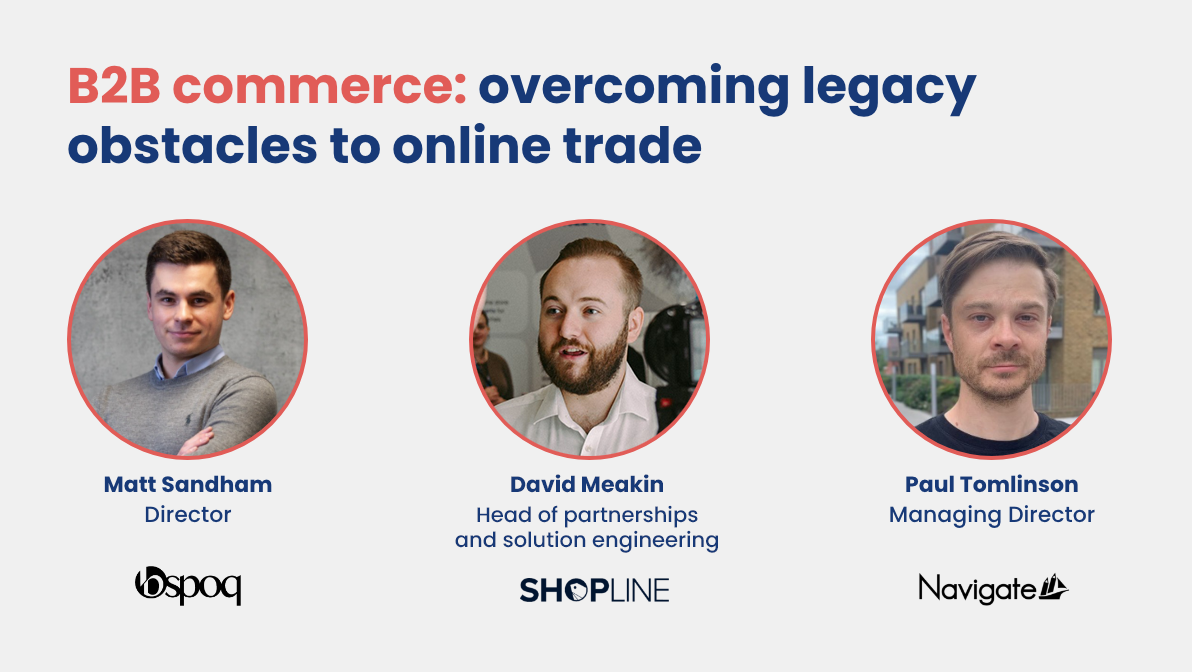
B2B commerce: overcoming legacy constraints to online trade
Companies embarking on B2B commerce projects should exercise caution as to their technology partners, and the depth of change required in their businesses.
By Paul Tomlinson, Published 01.04.2025
Interest in B2B commerce has picked up in the last two years, and certainly, there’s significant potential upside for B2Bs that move most or all of their trade into a webstore.
Yet as with most technological progress, excitement about the possibilities of B2B commerce risks distracting from the legacy constraints that will usually need to be overcome for a successful transformation.
To understand the current state of play, we sat down with two of the UK’s leading B2B commerce practitioners: Matt Sandham, founder of digital agency Bspoq, and David Meakin, head of partnerships & solution engineering at ecommerce platform Shopline. We discussed:
- the driving forces of innovation in B2B commerce, namely:
- removing friction and admin from buying and selling, allowing both customers and sales teams to spend more time on productive interactions
- optimising trade, by introducing and adapting modern ecommerce solutions for B2B
- the key areas of ecommerce development required to set up and optimise a B2B webstore
- the four main legacy obstacles that B2Bs will likely encounter during their project, both within their own businesses, and with some technology vendors.
The major inflection point in B2B commerce is likely to be in the coming 24 months, as vendor-side development accelerates to keep pace with customer investment.
Many solution vendors claim that their products are suitable for B2B, but in reality, the ecosystem of platforms, solutions and vendors is less developed than in the B2C world. Perhaps more importantly, B2Bs are likely to be at an earlier stage of digital transformation than enterprise B2C brands, without organisational experience of major development projects.
Companies can absolutely get started on B2B commerce now – and can probably carve out an advantage over slower-moving competitors if they do.
But, they should exercise caution as to which technology they choose, and with realistic expectations of the time, effort and depth of change needed in their own businesses in order to succeed.
Driving forces behind the growth in B2B commerce
B2B companies have enabled online transactions for over two decades, but the phrase ‘B2B commerce’ has far broader implications than simple payment collection or online SaaS subscriptions.
Really, ‘B2B commerce’ implies digitalisation of the industrial trade in physical goods, often by wholesalers, distributors and manufacturers. Payments and subscriptions are only one part of an ecommerce ecosystem comprising the customer experience (CX), backend services, optimisation, supply/demand chain, integration with other business systems, etc.
All these areas of ecommerce technology have been under accelerating development in the past 20 years. This has led to the standardisation of composable technologies, some of which are now sufficiently adaptable and extensible for the complexities of B2B.
Alongside technical progress, Shopline’s Meakin suggests that a cultural shift has helped to lay the path for B2B for commerce, as a new generation of professionals has challenged legacy ways of working.
“The new generation… they’re not the type of people to go for a pub lunch or a few beers to get a deal done…. You give them a spreadsheet, they’ll say, ‘What the heck’s this?’”
Meakin says that the high standard of user experiences (UX) in modern ecommerce, which help to save consumers from inadvertent purchasing errors, has made legacy B2B sites look untrustworthy by comparison.
“In the past, a lot of B2B sites were not very trustworthy. There’d be maybe a small picture and then a table of all the different options… if I’m going to place an order for a 100,000 pens and all I can see is a tiny picture, am I’m really going to do it?
Whereas now, they’re taking on more of the B2C experience, of being able to do a 360 of the product, etc. All the stuff that historically you did over a game of golf, they’re taking that online.”
Against this cultural backdrop, brand budget has started flowing more quickly towards B2B commerce projects to serve the following two business objectives.
Eliminating friction from the selling & buying process
Generally, the objective of B2B commerce development is to speed up trade and drive down the costs of sale. Sandham said:
“What we’re really talking about with B2B commerce is speeding up the transaction process: making the buying and selling of goods frictionless and creating an environment… where users in either organisation don’t have to jump through various different hoops and use various different systems to just simply place an order.”
A large proportion of B2B trade consists of repeat business to informed buyers – so businesses should rightly question how much of this repetition can be simplified with technology.
The caveat is that this ‘repetition’ belies a high degree of complexity, with characteristically high-value orders that vary significantly from one order to the next.
For example, a customer’s ‘usual’ monthly order might be $20,000, but turns out to be $35,000 in July, when they anticipate high demand, and only $8,000 in November. The makeup of the basket may also vary, if the customer becomes interested in new product lines, or if the sales team wishes to push new products or promotions. And with the high transaction values and fulfilment costs common in B2B, both sides are invested in minimising the risk of errors.
Other sources of complexity may include the need to configure certain products, or to personalise contracts, payment terms or fulfilment.
Historically, this complexity and risk was almost entirely absorbed by people: sales teams, with intimate product and customer knowledge, tailoring the order and the transaction. Hopefully, the sales team would also maximise trade – but this was alongside a lot of grunt-work when their skills could have been better deployed elsewhere. Sandham comments…
“At the end of the day, people predominantly buy from people… we’re having conversations now with brands around how much of the salesperson’s time is really being spent developing those relationships, on meaningful interaction with their accounts, and being able to build depth and loyalty.
In reality, a lot of their time is being spent on admin tasks. And the majority of these now can be handled by a robust commerce solution.”
So, it’s easy to see why all stakeholders might value an ecommerce setup.
Ecommerce optimisation and performance
At companies which have already moved their trade online, the focus inevitably moves onto optimisation.
Optimisation can take place across both cost-reduction and in revenue generation, and it’s a major source of incremental profit for ecommerce businesses. Illustratively: a retailer doing $100m annual trade that lowers costs by 1% will see $800,000 incremental profit each month.
On the revenue-generation side: Sandham explains that at Bspoq, they categorise these areas of focus as:
- acquisition
- conversion
- loyalty.
Acquisition mostly implies factors such as SEO and advertising that brings customers into the store.
Optimisation for conversion includes UX improvements, and also includes personalisation and localisation.
Personalisation relies on having a good command of the customer data, something which is currently limited amongst B2B firms. But this is changing, and we’re gradually seeing the ability to personalise offers based a customer’s purchase history, and other details in the customer profile, as is now fairly commonplace in B2C stores.
On localisation: we’ll discuss this more in the next section, but particularly for global B2Bs, making the store more relevant to local markets is a leading priority. Customers in different regions may need to see different pricing, tax, fulfilment information and documentation, far more so than in B2C, with the increased likelihood that the goods are subject to specific regulations, or involve specialised delivery.
As to loyalty: both Sandham and Meakin agree that email marketing is greatly underused in B2B, despite being widely recognised in B2C marketing as an effective means of motivating repeat business.
And B2B loyalty programs, which have been under the radar for over a decade, are now increasingly being deployed by wholesalers and other B2Bs seeking to retain customer preference in a competitive market. Loyalty marketing relies heavily on zero-party data, of which the ecommerce store should be a primary source.
Localisation, personalisation, loyalty, CRM – all these things have accelerated in B2C ecommerce thanks largely to developments in technology.
In B2B, the pace of development has been slower due to relative immaturity in the space, and so a smaller proportion of tech solutions will be suitable for companies’ needs.
The challenge for B2Bs embarking on ecommerce, therefore, will be to licence technology carefully, whilst also being prepared for the work need to get their existing data and systems singing in tune.
Developing an ecommerce store for B2B trade
The characteristics of B2B trade are such that an ‘average’ B2C setup would not be suitable for most B2Bs. In this section we’ll look at these differences, namely:
- the importance of direct human interaction in B2B commerce
- the steps of the ecommerce customer journey and how they differ from B2C stores
- the key focus on ecommerce localisation for B2Bs
…and discuss what implications these have for the ecommerce stack.
Human interaction in B2B commerce
In B2B trade, human sales reps are often not fully replaceable, and so need to be included in the digital customer journey.
Certainty, digital experiences can supersede in-person selling in some ways. Modern content management capabilities may present a vast UX improvement compared to product data sheets being carried around in a briefcase, and Sandham says that a high-quality, digital guided-selling experience can be a valuable competitive advantage for a business.
“It’s quite important as a differentiator… It’s not that difficult for anyone to spin up a fairly simple commerce solution in any space and start selling product at a low price. So it then really comes down to that experience… how can we recreate an in-person interaction in an online space.”
The need for human involvement in B2B trade is backed up by research recently published by Gartner, showing that a rep-assisted ecommerce experience actually gave the best chance of a happy customer:
“75% of B2B buyers say they prefer a rep-free sales experience, but 43% of B2B buyers are more likely to regret a purchase made via digital self-service alone than traditional, rep-led buyers (26%). When using rep-assisted digital commerce, regret drops to 21%.”
As a result, B2B web stores should be adapted to allow the salesperson to ‘pop up’ and lend assistance. Such help is most likely to be needed around availability-checking, price-checking, product expertise, comparison and negotiation – rather than in the administrative completion of an order.
As to the buyer journey itself…
The buyer journey, and B2B commerce’s ‘mutant limbs’
If you were to compare a typical B2B and B2C commerce stack side-by-side, the B2B stack would appear to have mutant limbs: certain areas which are far more highly evolved for specific purposes.
The ecommerce customer journey usually comprises three steps:
- the collection page
- PDP (product detail page)
- the checkout.
…so it’s useful to look at all these steps and see where B2B stores differ.
The ‘collection page’ in conventional ecommerce is a filtered view of a product grid, often with some SEO copy and imagery introducing or explaining the collection. They’re useful for customer who wants to shop various items in a collection in one place. For example, if the customer is shopping safety equipment, they might want to see all the high-vis jackets, helmets and safety harnesses on one collection page.
Meakin comments that, five years ago, a typical B2B collection page…
“…was just a table: tiny imagery, a bit of a description, and a ‘buy now’ button with a quantity. It wasn’t a way of enticing you to buy more.
Whereas now, the successful B2B sites that I’m seeing… It’s imaginative, it’s got really nice product imagery, it’s got recommended products… Five years ago, I would never have thought that we’d have had cross-sell, upsell, and recommendations on a B2B site.”
Beyond this, standard collection pages may actually hinder some B2B customer journeys. If a customer wants to buy multiple items which may be materially unrelated – i.e.:
- 16 high vis jackets, 39 safety harnesses and 24 helmets
- 7 replacement wind turbine blades
- the renewal of maintenance contract
- …and 370 litres of gear oil
…having to visit the collection pages for all these categories may just add unwelcome steps.
For this reason, companies may enable personalised collection pages for frequent returning customers, in order to reflect their buying habits and produce a tailor-made customer experience. Artificial intelligence may also be used to group products together for quick ordering.
On the PDP: B2B webstores may require far greater flexibility around product options due to the diverse and complex nature of products being ordered.
In B2C commerce, the customer would often select colour, size or quantity – but rarely would they need to tailor the product much further. In B2B, there may be many more diverse factors to choose from, such as product configurations and specifications, custom features, bespoke branding, high-volume bundles, etc.
Similarly to personalised collection pages: B2Bs may wish to tailor the PDP based on the individual customer’s likely needs. Meakin explains…
“It’s always going to start with the customer’s preferred action. If I know that a customer always buy 100 products, I’m not going to offer a single item or start the tiering at one.”
Finally, the checkout is where human interaction is most commonly needed, i.e., to negotiate pricing or check any final details before closing an order.
B2B customers are also less likely to pay upfront – which means that sellers have to account for greater financial risk. This makes it more important to be able incorporate credit checks, or customise contract terms or payment acceptance criteria.
Localisation of B2B commerce
Localisation is a major consideration for any ecommerce company which sells across borders, but B2B trade is more globalised than B2C.
Semiconductor chips, for example, are mostly manufactured in east Asia, but are required by electronics manufacturers in many countries. Scotch whisky is manufactured in only one country but is shipped to retailers worldwide. A lot of Italian-designed clothing is manufactured in China for global distribution to retailers and intermediary wholesalers.
This cross-border trade requires a great deal of adaptability in the CX. Beyond language, pricing in a local currency, and local promotions, B2Bs also need to account for factors such as:
- regulation – for dangerous products such as chemicals or heavy industry, and increasingly for sustainability
- tax – where import and export tariffs may apply differently in each country, as well as local sales tax at the point of purchase
- shipping – often combining freight by air, rail, road or sea, as well as last-mile delivery.
This need for ecommerce localisation has been a major driver of the evolution of headless commerce systems, particularly in the European Union, where cross-border trade is relatively deregulated – but where languages and cultures differ widely.
Sandham explains that global B2Bs would often require a single requires a headless backend for simplicity of management, feeding multiple storefronts based on the customer’s location. They may also need to know which storefront to present to a single customer that exists in multiple locations…
“A lot of B2Bs will be managing customer accounts across various different localisation points. So you’ll have customer who has an office in the UK but also has an office in the US and perhaps the Far East. So how does their experience differ on the different storefronts.”
…and/or need to take a different approach to customer service in different markets.
“There’s this misconception that localisation is nothing more then translating the current store into another language and changing the currency. But that ignores the nuances of buyer behaviours in different parts of the world and different digital maturity levels… and so we have to be able to adapt storefronts for that. Some customers need a little bit more handholding. Some of them need information that’s not available on others… some of them just need a completely different search experience.”
Today, practically every ecommerce platform vendor claims to have such headless capability. Meakin’s experience of developing the Shopline platform, however, illustrates that there is wide variety in the true capability of these products.
Beyond being able to localise content, Meakin explains, Shopline allows the customer to deploy different third-party solutions – i.e., for payment, search, tax and shipping – in different markets.
“The UK website can use our in-house search; the French website could use Algolia… because [the stack] is composed of different storefronts, you get the utter flexibility.
My pet peeve of other platforms is that you either use one PayPal account, share it between all locations, and let the finance team work out whether it was a UK or a US sale… Or you had to maintain two monolithic instances of webstore. So two patches, two license fees, two upgrades, twice as many hacks and integrations.”
Meakin says “a lot of engineering headaches” went into achieving this level of flexibility, but this effort was needed to alleviate the headaches experienced by customers using inferior tech.
Obstacles to a successful B2B commerce transformation
Meakin and Sandham agree that businesses invariably underestimate the time, cost and effort of embarking on B2B commerce. This is due to:
- cultural reasons: failing to anticipate how introducing a webstore will effect established processes, people and systems internally.
- the state of companies’ data, often requiring a data transformation project prior to being able to build the webstore
- limitations of the customer’s incumbent tech stack, in particular the ERP
- immaturity of available software for B2B commerce: both third-party solutions, and ecommerce platforms themselves.
The cultural factor may not even be considered until the company is part-way through a development project. But it’s possibly the most important consideration, since it has implications for how the company will adopt and implement its new tech.
Cultural obstacles to ecommerce for established B2B firms
If a business has never tried ecommerce before, it may never have previously considered how its chosen means of selling shapes the wider business.
In fact, the ecommerce webstore is typically one part of an ecosystem of platforms and solutions which pervade most of business. As a result, a high proportion of the company’s employees, and the nature of their roles, is determined by the company’s chosen commercial channels.
Meakin recounts that, during the covid-19 pandemic, some businesses thought that selling wholesale via B2B commerce might a quick and easy way to shift distressed inventory – not realising that this brought fresh risks that they weren’t accustomed to.
“They didn’t think about the regulations, the extra tax… they couldn’t just jump at it because they didn’t have financial systems that could do company lookups, company fraud checks, etc. And if you ship £100,000 worth of product on goodwill and the customer goes bust, you’ve lost £100,000.”
For these reasons, Sandham advises that organisations cannot just ‘dip their toe in’ B2B commerce; such underinvestment is likely to lead to a failed project.
“It’s got to be taken as seriously, as a completely new department within the business. It’s a new sales channel… it’s like employing a new sales team or opening up a new business unit. It’s that level of importance.”
For existing colleagues, such an extent of change can be daunting…
“…if you’ve had an established process in place for 15, 20, 30 years around human interaction, and now all of a sudden you’re saying a large proportion of that work is being handled by this new solution.
We can support those businesses with the cultural buy-in, by showing their employees that this really adds value.”
Securing that cultural buy-in will be crucial, as alliances throughout the business will be needed to carry out major transformation work to the company’s existing data, processes and systems.
The data transformation required for B2B commerce
Legacy data challenges are likely to be part of any ecommerce project, whether the company is just starting out in ecommerce, or upgrading its systems.
This is because the company’s data is less likely to be stored in a cloud databases, and/or structured in such a way that the new ecommerce platform can receive and interpret it. For B2Bs embarking on their first ecommerce project, there’s a good chance this crucial data is on spreadsheets, with no prior consideration given to how it might be shared and deployed across the business.
Data on products, inventory, customers, suppliers and financial information etc., will therefore need to be structured, and then loaded into a modern data stack in order to be useful for ecommerce.
We’ve previously written on how solving such data challenges can unlock major new commercial opportunities in direct-to-consumer commerce and in scaling the use of AI; the same can be said for B2B commerce.
Matt Sandham comments…
“B2C ecommerce is a lot more mature on the data front. When B2B brands add ecommerce as a channel, they find the data management that was sufficient offline world is nowhere near where it needs to be in an online world.
Very few have a PIM [product information management system], for example. They’ve never looked at fraud rates in the same way, or the compliance and safety requirements that might be valid in some continents. It’s a little bit of a Pandora’s box.”
This immaturity with data is, largely, a consequence of the immaturity of the systems in which that data is stored.
B2B commerce usually means updating legacy tech
Companies are often surprised to discover that their incumbent tech poses a major hurdle to development. Predictably, the biggest challenge here is likely to be the ERP (enterprise resource planning) platform.
The ERP is notoriously difficult to replace, since it’s connected to so many parts of the business. As a result, many ERPs in current use may be decades old – but the age of this piece of tech may not be the whole problem. The key challenge is that these tools are often heavily customised for the businesses’ specific requirements – requirements which may have long gone out of date, yet still need to be accommodated into any integration efforts.
Meakin recounts one instance of a client using the Microsoft Dynamics ERP…
“Dynamics is quite modern. It’s not an archaic piece of software. But at some point down the line, for the old commerce platform, the client had added five required fields – weird fields such as country of manufacture, date of birth etc., that were no longer needed.
Our ecommerce platform didn’t have those fields; there was no need for them to exist. But we had to build them into our system and leave them null, just so that we could migrate the client’s webstore and the ERP system could keep working.”
Sandham adds that outdated API documentation could equally complicate efforts to integrate a new ecommerce platform.
“We carried out an integration project recently for an ecommerce solution that we built on BigCommerce. The documentation that we were sent from the ERP solution was written in 2001. So I’m questioning how this is going to work.
If the solution to such problems is so convoluted that it might shorten the lifespan of this integration, we have to have a serious conversation about changing fundamental parts of your stack like your ERP.”
Unsurprisingly, then, ERP replacement projects are picking up amongst B2B firms. In a 2023 study by Deloitte Digital, of 530 executives at B2B companies with 1,000 or more employees, 45% of respondents were integrating their B2B ecommerce technology with cloud-based ERPs. A further 35% planned to upgrade their ERP systems in 2024.
Generally speaking, businesses should not expect an easy ride when integrating any legacy incumbent tech with a modern piece of software. But a further challenge is that modern software products themselves may require significant adaptation for B2B trade.
The limitations of modern ecommerce platforms and solutions for B2B
Technology companies widely bemoan legacy systems and practices at their clients’ businesses, but in B2B, the truth is that many technology vendors are still catching up.
Sandham gives the example of a recent project carried out by Bspoq for a well-known builder’s merchant. The company’s goods were sold in various units of measurement, some of which had not been anticipated by the ecommerce platform vendor.
“Some of the products were very bog-standard SKUs: tools and stuff like that. But they also had some products sold by volume, others by size, others by weight, others by bags, wood sold by length – which can also be cut to order, etc.”
Beyond the webstore, it also meant customising the UX on the product pages, and equivalent adaptations had to be made further down the tech stack.
“Then there’s platforms which can’t handle decimal points when tracking inventory, so in their world, you can’t have 1.5 metres of a product.”
Some solution vendors might tell customers about such limitations upfront; many won’t. Indeed, every ecommerce platform vendor that we benchmarked for this article claimed to have class-leading B2B functionality. Sandham says that…
“…some of the platforms are definitely taking liberties with their marketing. As B2B commerce scales up, vendors typically need to offer a lot more tools, a lot more personalisation, possibly multi-storefront, finance management, multi-user permissions, connectivity to APIs, etc. So that’s when the window becomes quite narrow for how many platforms can credibly make that claim.”
Meakin agrees that buyers should question the marketing spiel, and undertake careful research to figure out whether the product is necessarily right for their business. Indeed, not being suitable for everyone is usually part of effective product marketing, since it allows vendors to differentiate themselves in the market.
“Every B2B project I’ve worked on is different. So there’s going to be a percentage of projects where Shopline’s B2B proposition isn’t suitable… because we put limits on it. We have to be opinionated around how price lists are built etc…
If you gave Shop a B2B perishable goods project, we’re not good for that… I think it’d be the same for Shopify and BigCommerce… with the lead times on delivery and all the integrations that you’d need.
Whereas you give us the more generic B2B, i.e., traditional large goods or branded goods, we can solve that problem day-in, day-out. It’s just about understanding the company’s requirements first and then selecting the platform.”
Beyond platforms, the entire martech industry is still catching up to the idiosyncrasies of B2B. Sandham gives the example of email marketing vendors – who may see little B2B demand currently, but who can expect this to change.
“There’s few businesses out there who are actually using email marketing in their B2B strategy, but the big email marketing platforms are still not waking up to the opportunity. A lot of the tools that are available are still geared far more towards B2C marketing.”
Certainly in our marketing work at Navigate B2B, we’ve found all the leading email marketing tools to be cumbersome or overpriced for use with enterprise sales teams. We use Campaign Monitor, a lesser-known tool, for these purposes.
Where solution vendors are adapting for B2B, buyers should be aware that that they’re buying into a nascent and fast-evolving space where solutions may still be undergoing development. Sandham describes an industry-wide challenge, where…
“…we have updates to some SaaS platforms coming out that aren’t fully thought through. They will release new features which lead to further problems.
If you look at BigCommerce, a big part of their marketing now is focused around B2B and enterprise. They acquired BundleB2B over two years ago. Yet up until late 2024, it was still an app on their app store; only just recently have they added it into main dashboard. From the perspective of the professional using the system, that just adds an additional layer complexity.
And so it’s bits like that, as an industry, we’ve not really had time to master yet.”
Move fast with stable infrastructure
Being a ‘first-mover’ can either be an advantage or disadvantage, depending on how well you make that first move.
Whilst B2B commerce is now well-established in some ways, in other ways, it’s a space where many businesses can still expect to carve out an advantage, as their competitors are less likely to have taken the plunge.
Companies may have little time to act here, as Sandham and Meakin both predict that B2B commerce projects will accelerate in the coming months and years. Meakin said…
“We’re going to see the real wave in 12-24 months because people are now starting to think about that replatforming. Budgets are being set, they’re securing the funds for digital transformation… and that’s also giving our vendors, the CRMs, search and merch tools, time to catch up.”
…yet businesses should not allow the prospect of ‘being first’ to dominate their thinking.
Throughout the history of digital transformation, businesses have regularly suffered avoidable setbacks by underestimating the time, cost and risk associated with new technical endeavours. Meakin said his first piece of advice is:
“…do your research.
B2B projects are the worst to fail because of the bigger order volumes, greater complexity, typically a lot higher costs than a B2C project. Understand that it’s not just the storefront. It’s the whole supply chain, the warehouse management, the order management, even down to the barcode scanner in the warehouse.
So, don’t think that you’re just swapping out the front-end. Really do your due diligence and look at the platform capabilities all the way across the board.”
Nor, advises Matt, should companies expect a quick turnaround, especially if they’re embarking on a first ecommerce build, and/or laden with technical debt in their existing systems.
“One of the biggest challenges within B2B ecommerce is the speed of implementation because of the complexity of it, because of the number of systems and internal stakeholders involved. You’ve got to be open to the fact that you might have to strip out your existing ERP that’s been in the business for 20 years… that could be a 12-month project before you even get to the point of building and launching an ecommerce store.”
With the rise and rise of ecommerce, the opportunities now emerging in B2B are obvious to many. The obstacles, less so. Before rushing headlong into a costly, long-term initiative that will transform much of the business, as well as its technology, companies are advised to start by understanding the hurdles to clear along the way.
About the authors
If you’re considering your own B2B commerce project, please get in touch with this report’s authors to learn more.
 Matt Sandham is founder and director of Bspoq a marketing & ecommerce agency that consults with B2B and B2C brands, building and maintaining their webstores to maximise online and offline trade.
To found out more, visit Bspoq.com

David Meakin is head of partnerships & solution engineering at Shopline, a modern headless ecommerce platform that thrives in cross-border commerce, social commerce, B2B and more, for SMEs and enterprise brands.
To found out more, visit Shopline.com
 Paul Tomlinson is founder & managing director of Navigate B2B is a marketing agency specialising in martech & B2B SaaS, that augments sales with high-quality thought leadership and digital marketing.
Find out more at NavigateB2B.com