Slop: the AI threat to B2B content marketing
Widespread challenges with B2B content marketing cannot be solved with generative AI. Better strategy is the starting point to achieiving marketing ROI.
By Paul Tomlinson, Published 21.07.2026
Most companies today appear to be trying to use generative AI for content production – but few are doing so effectively.
This is partly down to the limitations of the generative AI tools available, but also because B2B firms have often struggled to produce effective content marketing, meaning that they lack the in-house skills and expertise to put tools like ChatGPT to best use.
You can read our article on this topic below, or if you prefer a page-turner PDF, you can read the the whitepaper here (no data capture required).
Loading Viewer...
B2B marketing content is supposed to be a commercial asset that drives inbound lead generation. It should make a customer trust you, respect you, follow you for a long period of time and ultimately buy something.
So, if your business’s founder or VP of Sales wouldn’t say something to a customer or prospect, it shouldn’t go on your company blog.
Most B2B content falls far short of this standard – and since generative AI tools are not crystal balls, you can’t simply outsource your content marketing efforts to an AI bot and expect them to produce the unqiue, invaluable customer insights that possibly only your salespeople or founding team holds.
Most company blogs, in my experience, are managed by marketing teams with little or no direct collaboration with sales. The authors tend to be early-to-mid career marketing managers, who may be very good marketers, but who’ve never held a sales role, and whose writing skills are typical of the average professional.
Surprisingly large companies have no ability to generate (or even calculate) marketing ROI from their content efforts – but this doesn’t stop them wasting resources by simply filling space on the company blog. So, when professionals now widely talk about using AI to accelerate content production, what we’re really talking about is accellerating ineffectiveness. Or, to put it more eloquently…
“If AI simply helps us do more of the same, faster, we’re not scaling impact; we are scaling mediocrity.”
Andrea Rule, Head of Large Customer ANZ, LinkedIn
The purpose of this article, then (and our new whitepaper on slop), is not to rail against the use of AI for content production. Rather, it’s to help companies realise that AI can’t replace specialist content marketing expertise or fix a content strategy that isn’t delivering. And hopefully, this will help companies focus resources on the things that can genuinely produce ROI.
In this article, we will:
- start by looking at the true success factors in commercially effective content marketing
- explain the fundamentals of how generative AI works and its limitations for these purposes
- look at the long-term systemic challenges which have prevented most companies succeeding at B2B content marketing
- where generative AI can be useful for content creation
The real point to emphasise here is not the wastage of resources on content marketing, whether by AI or human authors.
It’s the opportunity costs that businesses are incurring by failing to publish effective content marketing. The opportunity they’re missing out on is the ability to greatly extend their commercial reach, at a far lower direct cost than hiring more salespeople, with far greater long-term ROI.
The success factors in truly commercially effective content marketing
There are three main success factors in B2B content marketing:
- Utility. Can the customer use this information practically in their business, today or in the foreseeable future?
- Quality: is the content of sufficient depth, originality, detail and emotional appeal, that it can outrank competitors trying to surface for similar customer queries in Google and AI search?
- Differentiation: is the information specialised enough to your business that it attracts your ICP and produces largely pre-qualified leads?
The other stuff is just hygiene factors. Keyword targeting, technical SEO, backlinks, site architecture, page speed – all these well-known ranking factors from Google’s algorithms are now largely replicated in AI search and haven’t really changed in 15+ years.
Furthermore, every competent marketing team can now execute these fundamentals. You can pay for someone to build you a backlink profile. All the other hygiene factors can largely be executed by a virtual assistant (or with AI), and since everyone has access to the same tools, you have to assume everyone else is already doing these things.
So, the only sustainable advantage is producing a better product.
As far as utility is concerned: this means offering advice that helps a very specific audience solve immediate commercial problems. Truly useful content reflects conversations that are happening inside customer organisations today, using the language customers themselves use. It addresses the real axieties and priorities of your key buyer personas. This level of precision rarely comes from marketing research or keyword analysis. It comes from the daily exposure to customers that only sales teams, account directors and founders ever really gain; the role of the content team is to extract that first-hand knowledge and repurpose it as marketing information.
As to quality: contrary to popualar belief, quality is not subjective. The factors that make the difference between a top-ranking and second-rate piece of thought leadership are well known. Realistically, you need to be publishing articles in the 2-3,000 word region, in a rationally structured way, with an even balance of relevant examples and actionable advice – all while (ideally) making it interesting.
Differentiation is the consequence of doing both of the first two things properly. Publish something your competitors couldn’t have written, because they don’t possess the same insight, perspective or experience. Do it to a high enough standard that nobody else can better it – at least, not in your specific niche.
Realistically, the only way to achieve this is to embed an experienced content marketing professional with your company leadership or sales team. That person’s role is to ensure that the information you’re publishing is at the leading edge of conversations with customers and the company’s product/service development. This person also rely on their experience to push back against publishing anything that falls short.
Generative AI tools are derivative by design
Generative AI actually produces fairly good prose these days, and as the technology evolves the issues of hallucination and sycophancy, which have plagued most models up until now, will probably cease to be a concern eventually.
So, when we’re talking about ‘AI slop’, we’re less likely to be talking about wrong information or gaffes appearing in the copy, as we were only 6-12 months ago.
Slop, in B2B content marketing, is probably better defined as content which doesn’t meet the benchmark of commercially differentiated thinking, which is what really makes the content effective.
Large language models are extraordinary systems for recognising and reproducing patterns. They generate fluent language by learning statistical relationships across enormous quantities of existing text.
This makes them ‘OK’ at explaining established concepts, summarising published knowledge and reorganising information into coherent prose (though they struggle with the more detailed, 2,000- to 3,000-word arguments that rank mostly highly in Google & AI search).
But this is the most fundamental problem.
If an insight already exists across the public internet, AI may be able to reproduce or synthesise it. If it exists only inside conversations between your salespeople and your customers, it cannot.
Competitive advantage usually lives in exactly those conversations.
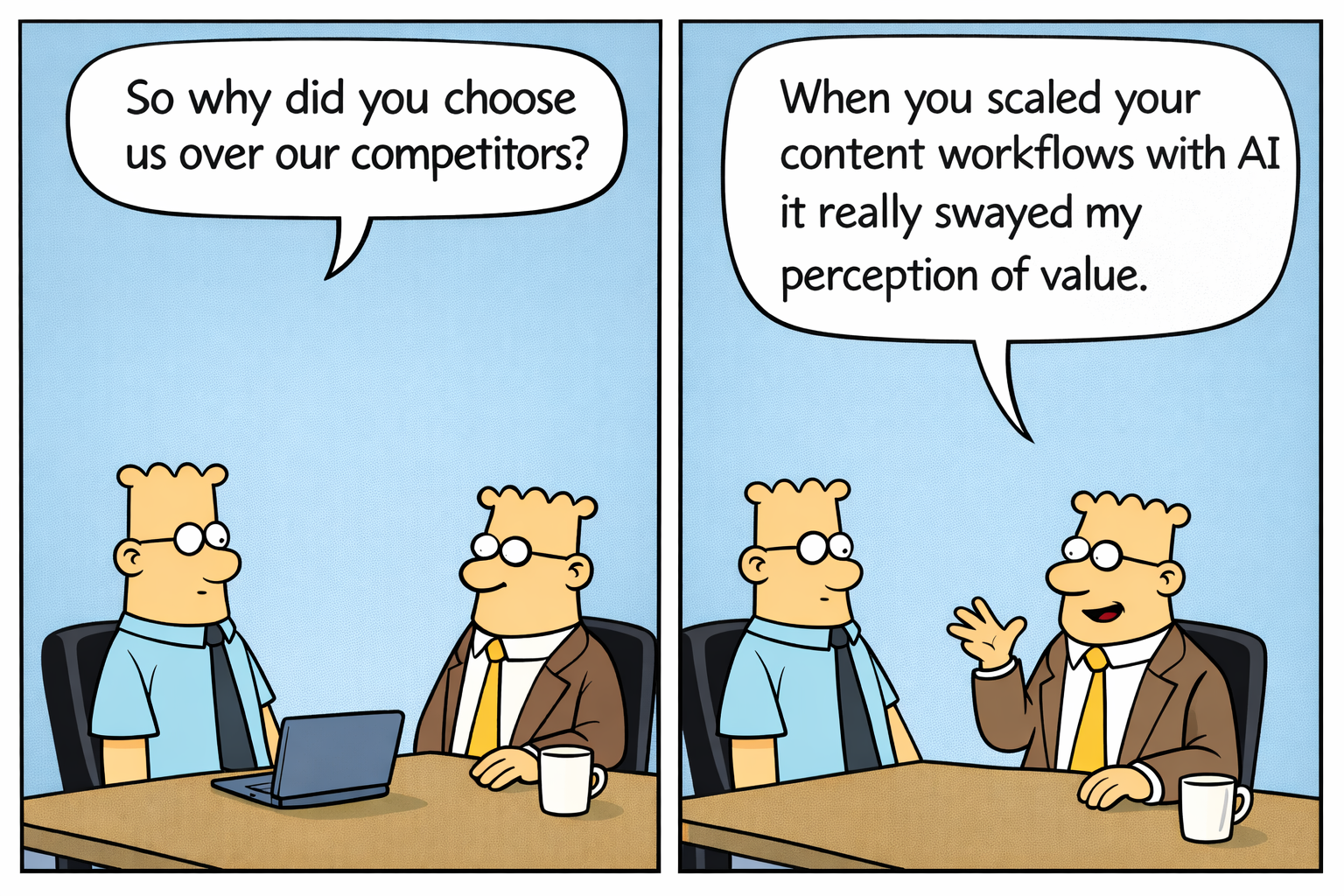
No language model attends customer meetings. None negotiates procurement exercises. None notices the subtle shift in questions prospects have started asking over the last six months. None develops commercial intuition through years of losing and winning deals.
These are precisely the inputs that produce differentiated thought leadership.
AI therefore struggles not because it is unintelligent, but because it has access to fundamentally different information.
The information at its disposal, too, is of variable and largely dubious quality – largely as a result of near two decades of poor quality content production by companies, which has produced a lot of shoddy training data for LLMs.
Systemic obstacles to success in B2B content marketing
Velocity Partners, a marketing agency, famously described this phenomenon as ‘crap’ in a whitepaper from 2013.
‘Crap’ is content that exists primarily because the publisher feels obliged to publish something. Company news. Generic management advice. Endless articles saying almost exactly what everyone else was already saying.
The roots of this problem stretch back to the early years of SEO, when search rankings could be manipulated through backlinks, keyword density and sheer publishing volume. Google progressively corrected those weaknesses through algorithm updates that rewarded genuinely useful content, but the production habits they created never disappeared.
Instead, many B2B organisations continued treating content as an industrial process. Marketing departments became responsible for maintaining publishing calendars. Teams were measured by the number of blogs produced each month – rather than whether those blogs helped to open opportunities and convert deals that the sales team otherwise would have missed.
With generative AI, the cost of production has fallen dramatically, yet we still have the same structural problems across the marketing landscape.
Marketers who don’t talk to sales.
Layers of marketing management, everyone with a remit to ‘write a bit of content’ but with no formal training and nobody using the analytics to optimize the strategy.
Small business owners who think they can ‘save’ on content marketing by DIY’ing it with AI – but ultimately incurring total wastage because their efforts fail to produce inbound traffic, leads and sales.
Accelerating the activity of these teams has done nothing to accelerate their commercial imapct; the AI has done nothing to help companies publish the right information, in the right formats, to have a realistic expectation of lifting marketing KPIs.
As The Growth Syndicate reported in their recent, ‘State of AI in B2B Marketing’ report…
“Most teams have integrated AI into their workflows. When you ask what’s actually improved, they point to time saved on first drafts, not revenue growth or customer acquisition.”
In the right hands, however, generative AI can be effective for accelerating the work of people who know what they’re doing.
So AI writes your content. But who asks the questions?
“Bad thought leadership starts with bad thinking, not bad writing. An interesting insight will always survive poor articulation. A hollow insight doesn’t improve with better articulation. AI amplifies whatever you put in, value or slop.”
Ferdinand Goetzen, Founding Partner – The Growth Syndicate
If you want to see the future of generative AI in content marketing you can look to examples such as the use of Claude for writing code.
Content production is different from coding, in that the users of technology aren’t really looking for ‘original insights’ in the way their software functions; they mostly just want it to work. This makes the potential efficiency gains far greater in software engineering.
That said, the example is still valid in that if you give the generative AI tools the right training data, they can assemble coherent concepts quite effectively, and also assist with the administrative aspects of production.
If you interview your sales team every quarter to find out what you should be publishing on, those insights could be fed into a generative AI tool (or programmed into a local LLM that your business may maintain). You could also train the software in your house style and feed it unstructured bullet points, allowing it to do some wordsmithing on your behalf.
But when we write a piece of content here at Navigate B2B, maybe only 20% of the effort goes into wordsmithing that final draft.
Most of the effort goes into working with a business to extract the intelligence that, perhaps they never realised, is gold-dust for content marketing. It goes into understanding their customer and structuring a narrative or an argument so that it meets them at ground-level, and guides them through complex ideas in a rational and sympathetic way.
It goes into making the content interesting, ensuring it has the named author’s voice, making it clearly better – more useful, more differentiated – than any competing business publishing on the same topic.
Personally, I am no fan of Elon Musk, but he knows a lot about AI and technology in general and this piece of advice is highly relevant in this discussion:
“[Automate] comes last. The big mistake in [my factories] was that I began by trying to automate every step. We should have waited until all the requirements had been questioned, parts and processes deleted, and the bugs were shaken out.”
Every new piece of content you publish is a microcosm of Musk’s automated factory.
If you try to automate from the start, you will only accelerate all the problems you have at the beginning of every writing process: disorganised ideas, and only some of the information you need to reach a final product.
Generative AI tools were never designed to do the work that makes B2B content successful – and in my entire career I’ve only met a handful of people that are really capable of doing that stuff well.
If you really want to save time on marketing, invest in getting it right first time. Any perceived savings from using the wrong tools will only ever produce negative ROI.
Save your content marketing strategy from AI slop
Read Navigate B2B’s whitepaper on this topic here – no data capture required.
Loading Viewer...