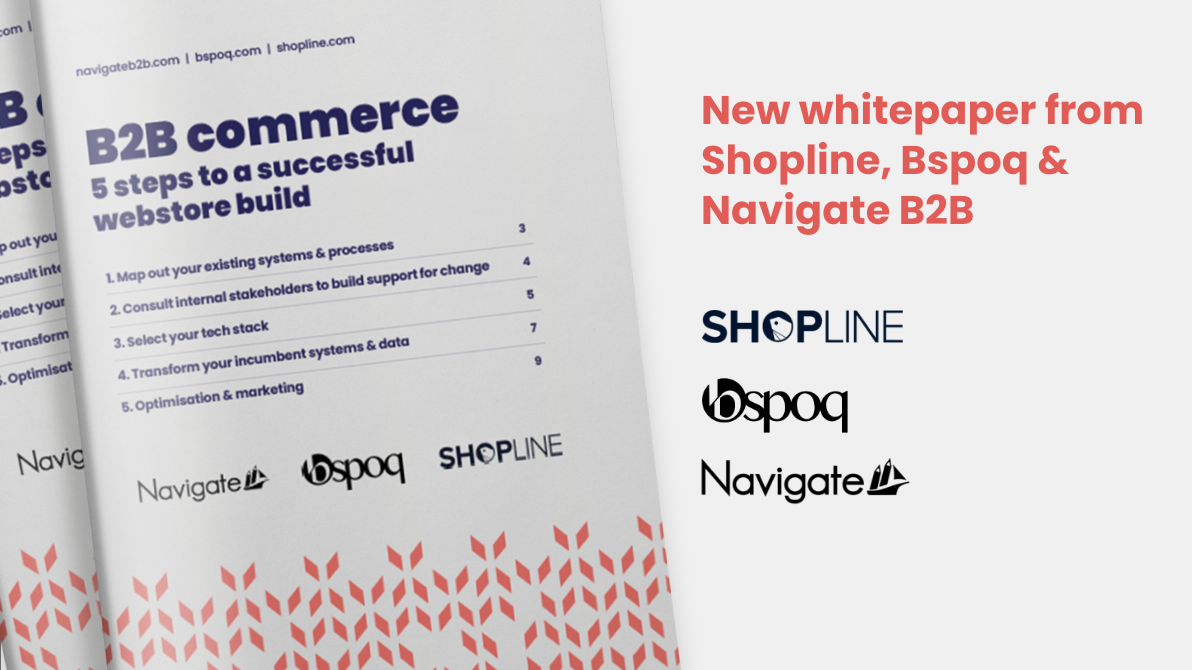
B2B commerce: 5 steps to a successful webstore build
There’s significant potential upside in launching or replatforming a B2B commerce store. But companies routinely underestimate the work.
By Paul Tomlinson, Published 01.04.2025
On top of the usual challenges of commerce replatforming, B2Bs typically have to deal with far greater complexity around product data, fraud, safety and compliance, as well as closer and more varied customer relationships. If the company sells across borders, they’ll also need to consider localisation, with tax and regulation in different jurisdictions.
All these have major implications for your choice of ecommerce technology, the time and cost of your development project and – most importantly – how these decisions may reshape your business.
The purpose of this whitepaper is to help B2Bs plan for a successful ecommerce build. It maps out the steps, and the probable hurdles you’ll face, based on our collective experience of delivering development and marketing initiatives for B2B brands.
Download the whitepaper using this form, or read on for a summary of the contents…
1. Map out your existing systems & processes
If you’re new to ecommerce, you may have never previously considered how your current means of selling has shaped your business.
In fact, your ecommerce project will inevitably force you to rethink more than just the website and your means of selling.
in all probability, your data and incumbent systems will require overhauling in order to onboard the new technology, and your existing processes may present contingencies you’d never previously considered.
Your findings during an inital scoping phase will give you a good head-start in knowing which technology partners have the right tools for the job.
2. Consult internal stakeholders to build support for change
Next, start an internal consultation process to ensure your colleagues are invested in the change, and to tap into organisational knowledge that will prove critical during the planning and webstore build.
Generally speaking, the person who initiates an ecommerce project – whether it’s the CIO, CEO, CTO, ecommerce lead – will know their own wheelhouse intimately, but only have a high-level view of how the rest of the business operates.
The sooner you tease out those details, the smoother the project will be, the more welcoming your colleagues of the change, and the less likely you are to see costs spiral.
3. Selecting your tech stack
As with any high-value purchase, you should exercise caution as to potential tech suppliers. Tellingly: our research shows that every ecommerce platform vendor claims to have excellent B2B commerce capability – but there is significant variation in how many vendors can credibly make that claim.
Beyond platforms: the entire martech industry is still catching up to the idiosyncrasies of B2B. B2Bs should be aware that that they’re buying into a nascent and fast-evolving space where solutions may still be undergoing development.
4. Transforming incumbent systems & data
Beyond platform capability: B2Bs should also expect to carry out significant work internally to accommodate the new tech.
The component of the stack most likely to cause a problem here is the ERP (enterprise resource planning platform). Managing this challenge will entail getting data off spreadsheets, enriched, standardised, and loaded into modern, cloud-based systems where it can be used and shared across the business.
5. Optimisation & marketing
Performance optimisation and data-led marketing are part of the ongoing mission of any ecommerce business. Much of this work takes place around personalisation and localisation.
Beyond localisation and marketing, headless commerce is now well established as the most capable technical architecture for a company seeking to put its data to work, and scale its business online.
About the authors
If you’re considering your own B2B commerce project, please get in touch with this report’s authors to learn more.
 Matt Sandham is founder and director of Bspoq a marketing & ecommerce agency that consults with B2B and B2C brands, building and maintaining their webstores to maximise online and offline trade.
To found out more, visit Bspoq.com

David Meakin is head of partnerships & solution engineering at Shopline, a modern headless ecommerce platform that thrives in cross-border commerce, social commerce, B2B and more, for SMEs and enterprise brands.
To found out more, visit Shopline.com
 Paul Tomlinson is founder & managing director of Navigate B2B is a marketing agency specialising in martech & B2B SaaS, that augments sales with high-quality thought leadership and digital marketing.
Find out more at NavigateB2B.com