
How to outmanoeuvre large B2B firms in Google & AI search
Smaller firms have unique advantages in search marketing which allow them to outmanoeuvre larger firms and drive inbound new business.
By Paul Tomlinson, Published 28.10.2026
The sales leader of a Brazilian ERP vendor recently told me that he questioned the value of investing in content marketing. Larger American competitors, he said, had already published so much content that they appeared to dominate search in his industry.
The marketing muscle of much larger competitors can certainly be intimidating to smaller firms – but it’s important not to be deterred by this. It’s eminently possible for smaller firms to compete in Google and AI search, as long as they follow the right strategy.
And smaller firms actually have some natural advantages which mean that, in their wheelhouses, they can often outrank larger competitors.
In this article we will look at:
- why the search algorithms appear to disproportionately favour larger firms – and the opportunities this leaves for smaller competitors, particularly in the age of AI search
- the natural advantages of smaller firms, with flatter commercial team structures, and being unburdened by legacy enterprise content marketing practices
- actionable advice on how smaller companies of any size can dominate their niche through content marketing and drive measurable ROI.
The same large firms seem to dominate search in many industries. I call these large firms the ‘barraqueiros’ of B2B content marketing.
- in tech, the barraqueiros are often legacy platform vendors such as Salesforce and Oracle; in Brazil, the TOTVS conglomerate ranks highly in many solution categories
- in professional services, they’re often management consultants. Accenture and McKinsey are ubiquitous in search
- and across industries, third-party publishers such as news websites, LinkedIn and review/comparison platforms often feature heavily in search results.
‘Barraqueiros’ is a Portuguese word which translates as ‘market stall vendors’ – implying a lot of businesses trying to outshout each other in a crowded marketplace. But it’s widely used to mean people who cause a lot of problems.
I characterise these larger companies as barraqueiros, or troublemakers, because in many cases, customers do not want an enterprise vendor. Yet the enterprises simply show up because of their sheer size and/or breadth of capability.
This can even include ranking in overseas markets; American companies regularly show up in Brazilian search results, even in contexts where Brazilian companies would probably prefer to work with a local supplier.
This phenomenon occurs partly because the search algorithms disproportionately reward firms for attributes common to larger businesses – but it’s also because smaller firms are more likely to under-invest in content marketing.
So, it’s important to understand the competitive landscape as a smaller business: the areas where you probably can’t compete, and the windows of opportunity that you should seek to exploit.
Ultimately, Google, ChatGPT and other search environments are now where a high proportion of customer journeys begin, and research shows B2B firms should make about 20% of their total new business from inbound enquiries.
The search algorithms are designed to ensure that the right customer can find the right supplier, however niche the requirement. So, it’s in the interests of companies like Google and ChatGPT to ensure this system works for both sides of the marketplaces that they serve.
But you’ll only win that slice of revenue if you play by the search platforms’ rules and anticipate those customers’ research needs with content marketing. Otherwise, those customers will continue to find the barraqueiros instead.
The ‘size prize’ explained: why large firms appear to dominate search
Essentially, large firms play favourably with the ranking algorithms thanks to:
- volume of content publishing. The search algorithms are designed to reward websites that are updated regularly, as a sign that they are well-maintained, current and therefore authoritative resources
- their size – since many common characteristics of larger firms also happen to be positive ranking factors in Google and AI search.
We’ll come back to volume of content publishing shortly. But here’s a summary of why these other algorithm factors reward firms unfairly simply for being large:
| Algorithm factor | Explanation | Why this unfairly rewards large firms |
| Brand prominence | If many people search for a term like ‘Adobe Commerce’, the algorithm concludes that the web domain is important. | Tracks negative interest. For example, a high volume of searches like ‘alternatives to Adobe Commerce’ could still raise the prominence of Adobe Commerce. |
| Backlink profiles | The algorithm assumes that if external sites link to your content, your website must be a useful, high-quality resource. | Large firms generate many backlinks unrelated to actual product value: from paid PR, M&A activity, or negative news (e.g., lawsuits, redundancies, poor performance). |
| Website engagement | High traffic and long user dwell times signal to Google that a website is highly important. | This leaves a gateway for a company to publish relatively poor content, since the strong website metrics from other areas of their website can create and sustain a positive feedback loop. |
Unfortunately, this often creates bad experiences for prospective customers in Google and AI search because many customers can’t or don’t want to work with large companies. By virtue of being a large enterprise, these firms’ solutions may be:
- expensive due to massive overheads
- poorly tailored for non-enterprise customers
- out-of-date or behind the curve, due to legacy architecture and/or corporate inertia
- poorly suited to certain markets (such as foreign and/or developing market countries) due to lack of market knowledge, experience, or affordability in the local currency.
These rules allow large companies to game the search algorithms more easily: essentially meaning they can publish a lot of short, generic articles and still claim many desirable search positions.
Yet herein lies the opportunity for smaller competitors.
Firstly: where big companies are good at publishing large volumes of poor-to-average content, they are typically quite bad at publishing the best content.
Secondly: no single ranking factor is all-conquering.
The search algorithms also reward high-quality articles, which are easier for small firms to execute, and which are likely to hold higher ranking positions for longer.
So, if your business isn’t large, or doesn’t have an enterprise content budget, it can still run an effective content marketing strategy with a realistic expectation of ROI.
Volume of content publishing: more isn’t always better
With large marketing teams, and often dedicated content marketing personnel, large enterprises can pump out large volumes of content on a scale that smaller businesses cannot.
In principle, there’s nothing wrong with publishing a lot of content, and for some highly competitive search terms it’s actually necessary to stay near the top of the search results.
Consider, for example, a company like HubSpot, which sells a general-purpose CRM that can be used by many businesses at many price-points. For such a business, short-tail search queries such as ‘CRM platform’ are relevant because they could well be searched by various different ideal customer profiles (ICPs).
However, this search term is so obvious, and so broad in its implications, that dozens of other companies are competing for the same territory.
This means that the search engines are continuously seeing fresh content on that topic, often from large firms with authoritative web domains, and so holding a desirable position requires significant ongoing investment.
Furthermore, this fixation on highly competitive search terms comes at a cost.
It means that large marketing teams are often beholden to dumb KPIs such as ‘number of blogs published per month’ rather than meaningful growth metrics such as website traffic, inbound lead generation and marketing-led sales.
And since this type of activity comprises such a great share of an enterprise’s content strategy, it makes it harder for these companies to focus on higher-quality, better-differentiated work.
*
Furthermore, this problem is actually worsening in the age of generative AI.
Enterprises are investing heavily in AI for content production, greatly accelerating the pace at which they can pump out content and also in an attempt to drive down operating costs.
But since they’re all using the same or similar AI tools, whose LLMs are often drawing on overlapping source data (i.e., the vast backlog of existing content on the internet) we have a scenario where several or even dozens of firms are publishing identikit landing pages and blog posts on the same topics.
The current state of play is basically like a race where all the runners are getting faster, but nobody is carving out a lead. On the contrary, such hijinks have been happening at such scale that it recently forced Google and the AI search tools to update their rules specifically to punish firms who appeared to be scaling their content production in order to manipulate the algorithms.
For further information, read our recent article & whitepaper: AI slop and the threat to B2B content marketing.

Smaller firms, meanwhile, can immediately focus their energies on much more productive approaches to content marketing with greater expected ROI.
Natural advantages of smaller firms in search
Many marketing teams assume that they want to show up on page 1 of Google / in ChatGPT’s top five recommendations when a customer searches for the simplest expression of their solution category.
But as explained, this is usually a fool’s errand – certainly for an early-stage company or a firm with little previous SEO/GEO traction, because this would pit you head-on against the biggest players in the market.
This is something that company founders generally understand very well, but many marketing professionals generally don’t consider (unless they’ve previously run a business). Business success is not usually about coming ‘first’, but about differentiating your business, so that you can have a share of the market.
Equally: search marketing is not a matter of simply ranking ‘highly’; rather, it’s a matter of outmanoeuvring other companies in your space.
In content marketing, outmanoeuvring larger competitors usually means:
optimizing for longer-tail search terms which directly relate to your expertise as a niche or specialist vendor
excelling at factors which are important in the search algorithms which larger companies generally find more difficult.
Other, highly important factors for the success of an article in search include:
- depth and detail: research shows that longer articles are likely to hold top positions
- originality of insight backed up by first-hand experience: this is increasingly important in the age of AI search, since the AI tools are sufficiently advanced to be able to assess whether the content is ‘original’ without waiting for performance metrics to build. This is known as the ‘E-E-A-T’ framework: Experience – Expertise –Authoritativeness – Trustworthiness, which is known to make content more resilient in Google and AI search
- page engagement – which is largely influenced by depth, detail and originality. The more useful someone finds the article, the more likely they are to spend time reading it, to link back to it, and share it with a friend or colleague
Depth, detail and originality (quality more generally) is where larger companies’ content marketing strategies tend to fall down. This is largely due to the way their organisations and marketing teams are structured.
While enterprises may have whole teams dedicated to content production, their nearest colleagues are other marketing professionals; it’s relatively rare for a content marketing manager to work closely and regularly with a senior sales colleague in an enterprise.
Indeed, in an enterprise, marketing and sales may not even work in the same office.
With this level of detachment from sales, enterprises’ marketing content is often starved of the first-hand experience and expertise, and the up-to-date customer insight that companies collect from their sales processes.
By contrast: in a smaller firm, the content writers or producers are more likely to collect first-hand customer insight from the sales team in the office. They may even have access to the founding team, and be able to translate that founder’s invaluable perspective, on a unique set of customer problems, into truly compelling content.
The opportunity: own your content marketing niche
The importance of long-tail search term is widely understood, but it’s worth reemphasising today, because with so many businesses using AI in place of human content marketing professionals, they risk passing over 20 years’ experience in content marketing best practices.
What perhaps is less appreciated, even by the content marketers, is why this approach is so effective: greatly increasing your marketing audience by addressing searches that commonly occur earlier in the funnel.
The potency of niche, high-funnel search terms in B2B content marketing
Take, for example, a hypothetical ecommerce checkout app.
The existing players in this category include specialists like Checkout.com, enterprises like Stripe, and platform vendors like Shopify who may offer checkout apps within their own product ecosystems.
Hardly any SME or new market entrant in this space would seek to compete head-on with Stripe (certainly not until they’ve achieved significant scale).
More likely, they want to differentiate by factors such as:
- market tier (small business, mid-market or enterprise)
- integrations with the customer’s technology stack (Shopify, Adobe, headless platforms, etc.)
- payment methods (e.g., cryptocurrency, loyalty points)
- …or the customer’s business category (B2B payments, for example, may involve an exchange of contracts, part-payment upfront, variable settlement terms, etc.).
When you start digging into the company’s niche, you immediately start spotting language that can be used to create highly differentiated content that directly speaks to your ICP (“how to accept loyalty points as payment”, for example).
For further colour: this table shows a range of other examples of fairly crowded SaaS categories. The categories in the left column could, themselves, be short-tail search terms (i.e., “recruitment CRM”). But when you look at the corresponding long-tail searches, you can see they relate to vendors in entirely different niches, with totally different ICPs.
| Broad category / short-tail search term | Example long-tail search | Implied company niche |
| Recruitment CRM | “How to reduce candidate attrition through long vetting processes” | Specialist in regulated industries (e.g., nursing, policing) |
| “Recruitment CRM white labels for recruitment process outsourcing (RPO) ” | Specialist in private enterprise recruiting, possibly for tech-forward firms | |
| ERP | “How to track fabric wastage and remnant stock across multiple factories” | Textile-specialist vendor |
| “How do we automate different IPI calculations across our product range” | ERP vendor targeting or originating in Brazil (Imposto sobre Produtos Industrializados) | |
| Loyalty platform | “Loyalty platforms for distribution companies” | B2B specialist vendor |
| “How can my coffee shop customers earn Air Miles? ” | B2C specialist vendor (implies POS integrations) | |
| Ecommerce checkout | “How to integrate sales negotiation into our ecommerce checkout workflow” | B2B platform vendor |
| “Can customers buy subscriptions and one-off products in the same checkout?” | B2C platform vendor, possibly specialising in direct-to-consumer (DTC) brands |
Granted: most larger vendors will probably be aware of many of the same long-tail search terms as you, but the chances are, they will only execute against them to the same, average standards that characterise the rest of their content strategy.
This territory is your opportunity to show what you do best, by publishing the best content in your wheelhouse.
Niche search terms can be a lot more productive
As well as being less competitive, niche search terms can also have far larger audiences. This may sound counter-intuitive, because ‘niche’ also often implies ‘small’. But it comes down to funnel-stage.
Customers research their problems more or less daily, and at large scale. But they act on these problems much more slowly – due to budgetary restraints, corporate inertia, and the simple need to consider their purchases before buying.
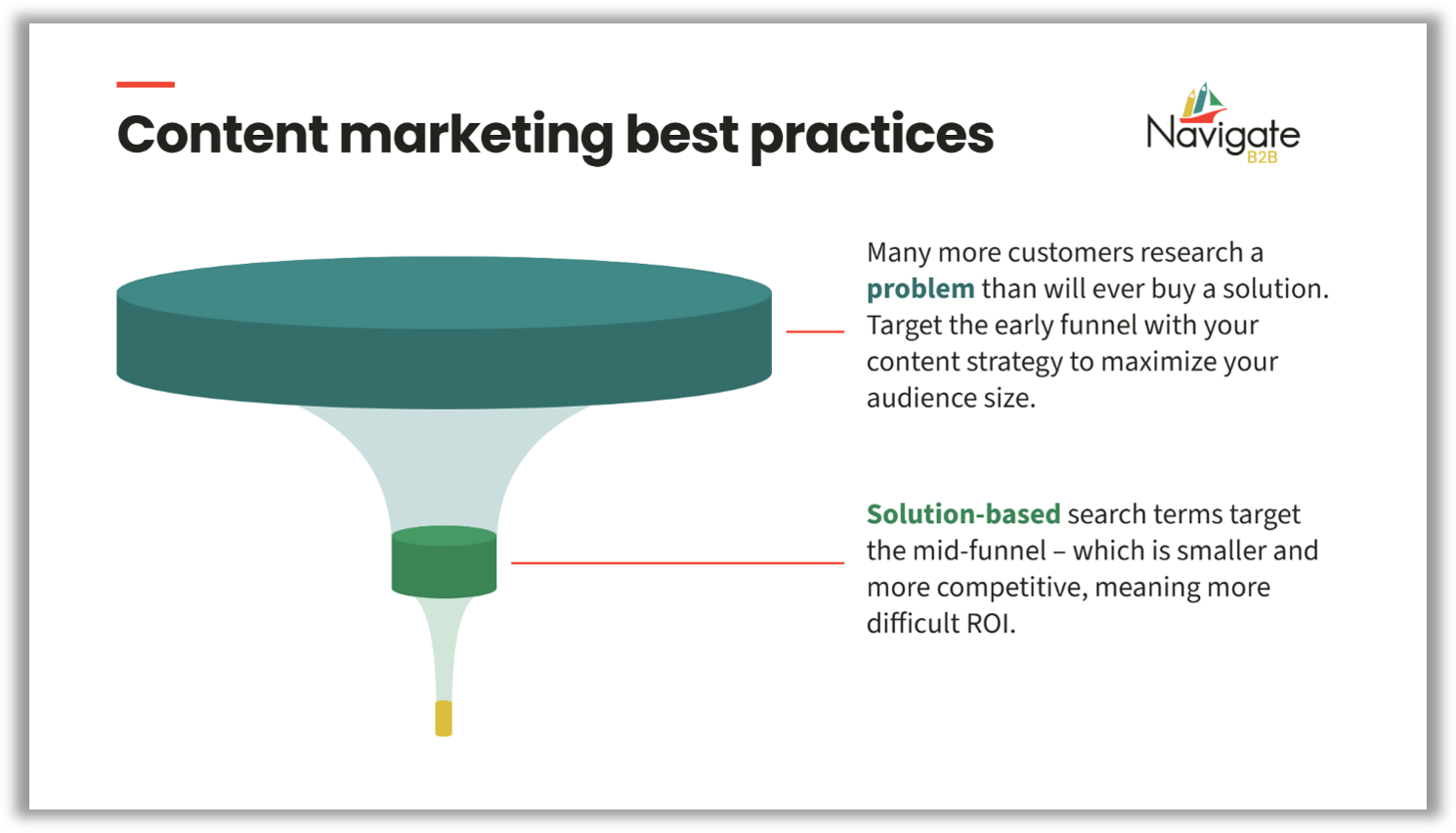
For instance, if a retail chain decides to change its point-of-sale (POS) hardware vendor, that decision will probably follow months, if not years of research and internal meetings.
At the middle funnel-stage someone will probably produce a short-list of vendors from a search in Google or AI, and then perhaps only between 1 and 5 stakeholders will sign off on the eventual buying decision.
But that whole journey may have started with a problem experienced by many, even dozens of middle-managers in the business, who were researching issues like:
‘Why can’t our POS integrate with our loyalty platform?’
…or…
‘How to issue e-receipts rather than paper’.
…and eventually, this ongoing troubleshooting causes problems to be flagged to senior management, leading to a proactive buying process.
Crucially, these high-funnel search terms are needed to add critical mass to your inbound pipeline. Since the mid-funnel is highly constricted, you will only be communicating with the small share of companies that have arrived at a buying need at a given time.
Amongst the far larger, early-funnel audience, meanwhile, are many more companies who could be potential customers – but who you may never discover had you not anticipated their research needs with content marketing.
In our work at Navigate B2B, for one longstanding SaaS client which initially targeted the travel industry, we effectively opened up an entirely new customer vertical (payments startups) because the customer problems, that we were publishing on, turned out to be common to professionals in more industries than we had previously realised.
For known and unknown ICPs alike: this brand recognition and multi-stakeholder engagement is often crucial to getting onto those companies’ shortlists and ultimately capturing the sale.
As a smaller firm, you may not have the universal brand recognition of Adobe Commerce, TOTVS or Stripe, and so without that marketing pressure, you could easily lose the sale by default.
But if you can address many stakeholders at an organisation with your marketing, you can sneak under your competitors’ radar and win the hearts and minds of many new clients – possibly for months or years before you even realise that prospect is there.
How small firms can rank for competitive keywords (eventually)
Of course, many companies do want to compete for the more obvious, short-tail keywords.
One longstanding client of ours is a commercial printer which positions around sustainability and only takes high-end, B2B work. Sometimes, customers searching for ‘sustainable printing’ are a perfect fit for our client’s ICP (ideal customer profile) and we don’t want to miss out on those enquiries.
Proactively seeking to compete for that term from the outset would have been prohibitively expensive, not least because it also produces a lot of irrelevant results. For such an obvious search term, this business competes with hundreds of consumer-facing printers (holiday photos, wedding invitations etc) and these end up clogging up the company inbox. But that’s a nice problem to have since it also turns up some quality leads.
This happens, today, because it now has the digital footprint typical of a much larger firm despite only being a medium-size player, thanks to years of strengthening its domain authority and brand prominence through productive content marketing.
This means it can practically and affordably compete for short-tail search terms – whilst never having proactively wasted resources on such a difficult task.
Universal truths of B2B content marketing for all businesses
The same set of rules (i.e., the search algorithms) applies to every business. What’s different, depending on your size, is your ability to execute against those rules in order to maximise your inbound new business.
Regardless of your scale, Google and the AI search platforms reward high-quality content. If the content is of a low standard, your content marketing efforts could produce negative ROI, regardless of how many articles you publish – and certainly will if you lack the high domain authority and brand prominence of an enterprise.
It’s difficult for enterprise content strategies to prioritise quality and detail, largely for structural reasons. Marketing people are mostly management professionals, whereas a good content marketer is an odd mix of creative talent with sales awareness. This makes it a tricky skillset to hire for and manage.
More concerningly, many small business owners also appear to be unaware of this. This is why we now see many promising or already successful firms, producing poor content with AI, lacking both the expertise and the expectations of prior success needed to make those efforts pay.
For all firms, focusing energies on a smaller number of higher-quality resources has always been an effective way to carve out and own new niches in the search results.
A highly detailed, genuinely useful piece of advice for your customers, based on up-to-date insight from sales, that addresses your customer at a senior level, will often produce greater ROI than dozens of poorly executed articles combined.
For small firms which naturally belong in a niche, that can be the entirety of their content strategy. For large firms which need to own broader swaths of territory, it could be a useful complement to their existing content production process and help them reach into verticals or audience segments.
Google and the AI search platforms are simply a type of marketplace, and for all the flaws in their algorithms, they do ultimately reward investment in good strategy.
At the end of the day, every business is in a competitive market for customer attention. In the competitive market for customer information, the best content will often win.